
Lately I’ve been engaging with only the ranked and competitive modes in video games. I guess I just don’t like fun anymore, suffering is the only way I feel alive. However, after spending hundreds and even thousands of hours playing competitive modes across a wide variety of genres, I came to a singular conclusion: ranked and competitive matchmaking is a scam.
Now some of it is definitely a case of what modern gamers would call “a skill issue” and the solution is to “git gud” and I realize that. There is something larger moving in the shadows of game development that is more nefarious in nature. In order to illustrate my point we can go back and observe what ranked and competitive matchmaking looked like in the past and compare it to present day matchmaking.
I remember the concept of ranked matchmaking way back in my college days. Those were fun times. I would skip class just to play Team Fortress 2 which had just come out in the Orange Box bundle. The sheer amount of “the cake is a lie” references would make one shudder. Anyways, I was playing a copious amount of Dota 1 as well, which was just a Warcraft III mod back in those days and that was where I was first introduced to the concept of ranked matchmaking. There would be a bot that would record and track your estimated skill level by assigning you a skill number and the bot would to try to match you against similarly skilled opponents.
As time went on, the concept of ranked matchmaking and an assigned skill level became more prevalent. The goal was simple back then, the only purpose of matchmaking was to determine your true skill level as accurately as possible and give you fair matches by matching you with and against similarly skilled opponents. The goal of people choosing to engage with ranked matchmaking was to play competitively and to get better over time. There were definitely flaws to ranked matchmaking. No matchmaking system was perfect and instead of a system that was based on true skill (which is very hard to approximate), it became a system that was based on rank. Here is what I mean. A high level player in bronze is quite obviously not in the lowest skill tier of the game but that’s what their current rank happened to be. The system would match the high level player against other bronze players but since they have a much better grasp of the game, they should theoretically win more games than lose and manage to climb to a higher rank until they hit an accurate approximation of their true skill level.
Now this is the ideal situation but the nature of competitive gaming, especially team oriented games, tell a much different story. Since team oriented games depend heavily on other players, tracking only wins and loses may not be an accurate metric of skill. For example, a high level support player in Overwatch 2 would have pretty high damage and healing numbers while keeping the number of deaths relatively low. Utility, however, is something that is a bit of an amorphous metric that is much harder to track accurately. For example, how would the matchmaker be able to tell the difference between a sleep dart that denied an ulting Genji that would have wiped the team versus a sleep dart that had no value. This is something very hard to measure. Wins and loses were the main metric game developers were able to track back in those days as well as matchmaking theory being something relatively new. This resulted in a system, that, for better or worse, revolved heavily on your current rank determined mostly by wins and loses instead of true skill. Your rank was as close an approximation to your true skill as the developers could get to. The sole purpose was still, to as accurately as possible, determine your true skill level and give you as fair of a match as possible.
Now fast forward to modern day gaming. If you scroll through the forums discussing any modern game that has a competitive mode, the discussion of ranked and competitive matchmaking is usually one of the prominent discussions, with complaints about the matchmaking being at the forefront. There is a reason for this and it goes beyond the mere possibility that the implementation of the matchmaking is severely flawed. I would like to posit here that the real reason of discontent is that the sole purpose of modern day competitive matchmaking has shifted from accurate skill prediction and fair matches to a system that is solely designed to take up as much of your time as possible with little or no thought given to fair matches. I will of course back this claim up.
Let us first take a look at the issue from a logical stand point based on how game developers act as a corporation and then look at the actual factual evidence that supports these claims and take it beyond mere speculation to the reality that is modern day gaming.
Now when I make these claims, I’m not saying they are true for every game developer but it certainly is more plausible and prevalent for larger developers, especially those with public stock offerings. The first thing to consider for the shift in modern day matchmaking design, is that an increase in engagement by the player base leads to an increase in the likelihood that they would engage with micro transactions. This is something that gamers see on a regular basis for most modern games from bigger developers, even single player games and cooperative PVE games. Games such as Warhammer 40k Darktide, and Diablo Immortal come to mind as more recent examples that I have personally come across. Competitive matchmaking is by far the easiest and cheapest way to get an increase in engagement from players. Single player games and PVE games require you to create actual content in the games, where as a ranked or competitive mode only requires you to have rank indicators. This is by far a more cost effective way to get an increase in engagement, leading to an increase in micro transactions being purchased, leading to an increase in profitability. This makes the company more attractive to potential investors as well.
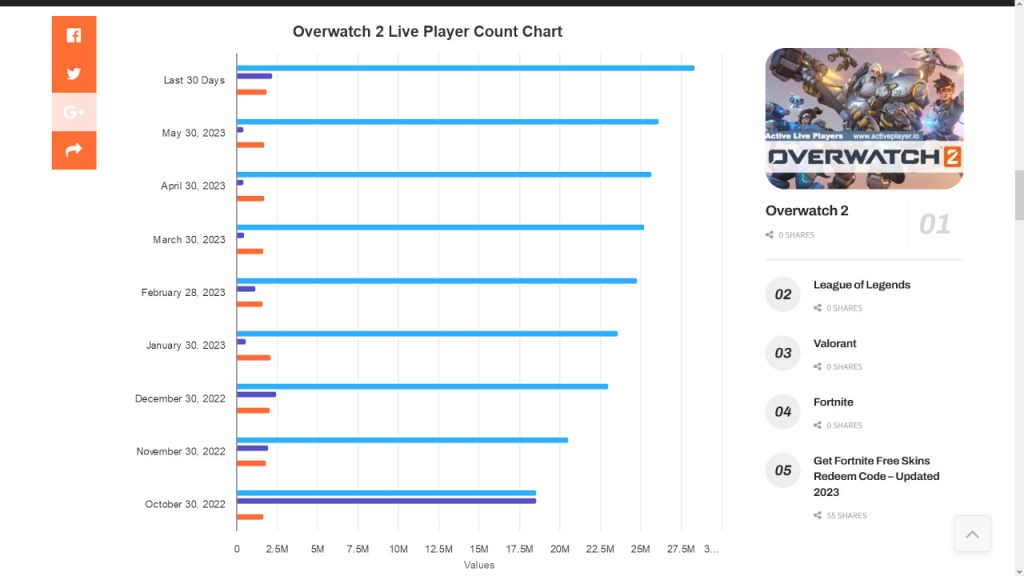
Even if the increase in engagement did not lead to an actual increase in the sales of micro transactions, engagement metrics are something the developer can leverage in terms of being more appealing to investors, thus leading to more investment funds or the continuation of investment funds.
The second, more nefarious reason for the shift in matchmaking design is that by simply retaining your engagement, you are spending way less time with competitor products. This concept is seen in the big tech companies, especially those dubbed as FAANG, Big Tech, the big five, etc. Large corporations such as Facebook, Amazon, Apple, Netflix, and Google spend hundreds of thousands of dollars PER SINGLE EMPLOYEE, not because they are that valuable, but in order to prevent them from going to competitors. There are are a lot of coders going over this on YouTube if you would like to go down the rabbit hole of large tech companies and how they operate. It’s quite fascinating as well as terrifying.
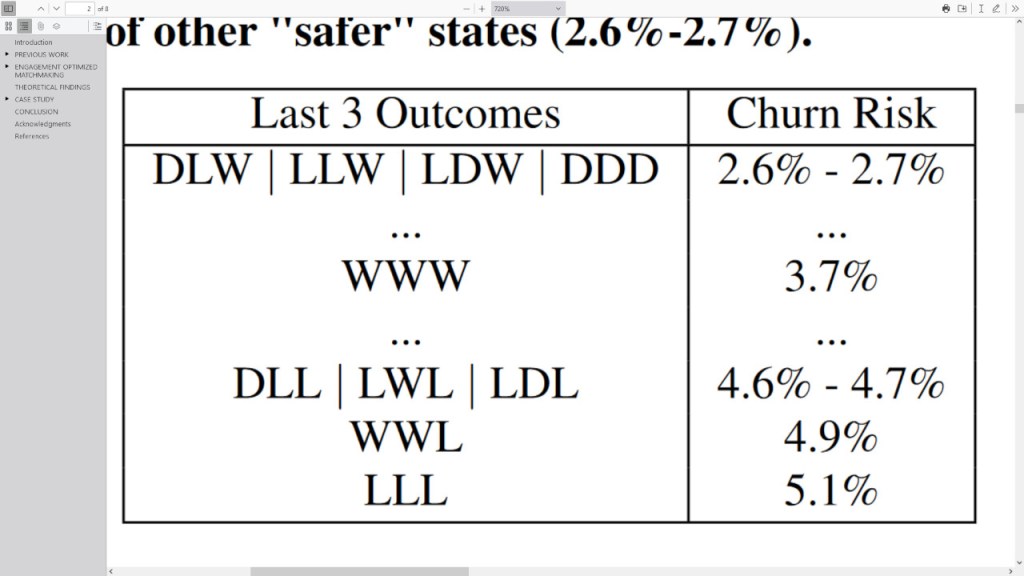
Now these claims are only speculation at this point so let me introduce to you two pieces of evidence as proof and food for thought. The first comes from everyone’s favorite company that killed Titan Fall, Electronic Arts or simply known by their abbreviation EA. This should come as no surprise to anyone familiar with the company. EA has been employing research into what was being called “Engagement Optimized Matchmaking”, sometimes referred to as EOMM. The whole purpose of Engagement Optimized Matchmaking is to increase engagement by observing when players decide to quit playing games. I am not joking, this is real and something they refer to as “churn risk”. A lower churn risk means less people are likely to quit. The paper looked at the last three outcomes of players’ matches and with their current data set, the recorded churn rates in the paper given as examples were 2.6 to 2.7 percent if the last three games ended on a win or a draw. A series of straight wins resulted in a churn risk of 3.7 percent and games ending in a loss resulted in churn rates from 4.6 percent to 5.1 percent. Now the difference between 2.6 percent and 5.1 percent may seem insignificant but when you consider EA has games that millions of people play at any given day, that extra 1.5 percent of people staying makes a large difference.
Now what does this mean you ask? That’s right, a series of games that have a loss and ending with a win result in lower churn risk. This is something the matchmaking is tuned to attempt to replicate. The paper even talks about deploying neural networks to more efficiently analyze engagement rates and calculate a series of wins, draws, and losses in order to engineer a lower churn risk. The matchmaking no longer cares about approximating your true skill and giving you as fair a match as possible. Its main purpose is to make you play as long as possible. I’ll leave you with a quote from the paper: “equal-skill based matchmaking is actually worst among all matchmaking schemes, as its goal to create close matches contrarily minimizes the overall player engagement”. Player engagement is the most important metric. I’m looking at you Overwatch 2!
The second piece of evidence and additional food for thought comes from Activision and again this by no means is a surprise to anybody. Activision actually patented a matchmaking system that’s main goal was to pair a higher skilled player with skins equipped with a lower level player. The logic behind this was that the lower level player would see the higher level player tear through lobbies and be more inclined to purchase the cosmetics they are wearing or cosmetics in general. I am not making this up, this is real. The corporation run dystopian future is now.
Now there are more pieces of evidence as well as anecdotal observations from the gaming communities out there but they are too numerous to cover in this article so hopefully these two pieces of evidence are enough to show that game developers and publishers are intentionally designing games with the sole purpose of taking as much of your time as possible and to increase engagement with micro transactions. The point here is that the irrefutable intentionality is there and not only does it simply exist, it is acted upon.
I will end with some personal anecdotal observations and my own experiences in engaging with these systems.
I poured over a thousand hours into Apex, about nine hundred hours into Overwatch Comp, and approximately over three thousand hours into Dota2 as I played the game when play time tracked was not an available feature in Steam. For Apex, I remember how comp was like. For bronze, it was actual bronze players. I would see people with no aim, no movement, and generally no game sense as people would just run across open ground not paying any attention. It would be relatively easy to hot drop every game and stomp my way to plat. Plat was where my skill level was tested and I could no longer hot drop but had to play more carefully and pick and choose my engagements. I had to get better at the game to climb. This is how how ranked matchmaking should be. If you do not belong in a certain tier, it should be easy to climb out, but it also means that people would spend less time with matchmaking. They would have an easier time climbing to their approximated skill level and then have a more difficult time ranking up. This is where most people would quit and either play a different mode or a different game.
Now fast forward to current Apex. Everyone who played Apex regularly, did notice a difference in matchmaking after a certain point where even bronze matches were incredibly sweaty. Even in the lowest levels of Bronze, I would see people that would line up a perfect beam to my head and I would constantly see people tap strafing, making them more difficult to hit. These were obviously not bronze level players. The sole goal of this matchmaker was to make sure I spent as much time as possible playing ranked. The present implementation of ranked in Apex makes this even more clear. Instead of ranking up based on skill, you will rank up based on placement. If you are in the top ten, you are guaranteed a positive twenty Ladder Points (or LP) regardless of if you have any kills or not. If you are not in the top ten, even with like five kills or so, you will end up with negative LP and to make matters worse, you can now derank in Apex. This means not dying is the main goal of ranked and this lets anyone who chooses to rat to be able to climb the ladder. However, the tradeoff is that you will spend way more time climbing.
To climb one tier, for example from bronze five to bronze four, it would take one thousand LP. If you were to place in top ten in every single game (which would be difficult to do) and take roughly twenty minutes per game doing so, that would result in seventeen hours per tier. That’s around eighty five hours per division. That’s around five hundred hours to reach diamond just by ratting to top ten every game. Now it would take less time for a skilled player but those in the upper echelon of skill make up an incredibly small percentage of the player base. To make matters worse, the game now matches you based on a hidden mmr estimation and not your current rank, making winning firefights in Apex much more challenging. The vast majority sit in the lower ranks and this means a lot more people are going to spend way more time playing ranked because now it’s much easier to climb in exchange for spending way more time ratting.
Don’t even get me started on Overwatch 2. I could make an entire video series on how terrible Overwatch 2’s matchmaking is but I’ll just give it a brief, dishonorable mention as the worst possible matchmaking system known to gamerkind, especially when compared with Overwatch 1.
Now some may say if the matchmaking systems are that deplorable, just choose not to engage with it. The problem is that these systems are incredibly deceptive and engineered to be incredibly addictive, just like a digital drug. Just look at concurrent player counts for these games. And just like a drug addict that has built up an immunity, I only play these games to avoid a low. There are no more highs and that is one reason why I don’t enjoy modern games anymore and why I believe ranked and competitive matchmaking to be a scam. Thank you for your time and thank you for reading this article. If you would like to share your thoughts and experiences, please feel free to leave a comment down below, I would love to hear from you guys. And as always, hope you guys are staying sane and safe out there, and catch you guys next time.
Also #FBlizzard.

 Ducky Obrien